Sustainable Saturday Bike Ride
Ya'll come, see ya there.
 |
| Click for Details |
-LS
Sustainable Saturday Bike Ride
Ya'll come, see ya there.
|
| Click for Details |
-LS
The Vision 2030 Strategic Plan begun in 1999 begins this way:
What will Laguna Beach be like a generation from now? In thirty years will we congratulate ourselves on what we have achieved or lament on what we have lost?

It's almost 2030, what has been done? What remains to be implemented? What are the new issues since 1999? Do we know where we are going (read chart)?
The original Vision 2030 Strategic Plan printed in 2001 has been lost, only a poor scanned copy of the original remains on the LB City website. The site www.visionlaguna.org has expired. What should be done to restore this guiding testament to LB resident values?
The plan has been updated for relevancy in 2023, rewritten in digital (pdf) format, searchable and answers those questions.
Laguna Beach Vision 2030 Strategic Plan REVISED
On 23 April 2023 this REVISED Plan was submitted to the LB City Council,
the Planning Commission, and to select residents for comment, to date
none were received.
-LS
-LS
The motive for public transit has been known for a while: vehicles specifically cars, just sit around Laguna most of the day and require public or private parking space. Our Laguna Beach Transit Director Paula Pfaust (retired) tells us the LB Trolley costs $16 per boarding, while the LB Transit Department is planning to buy a new fleet of electric LB Trolleys for $250,000 each. When a transit boarding is FREE, these costs are subsidized by city resources, often state and federal grant funding and municipal bonds. And now due to low ridership some Trolleys no longer serve residential routes.
Meanwhile electric mini car-shares are catching-on in the United States and Europe costing little as 29-cents per minute plus a small membership fee. Maybe electric mini car-shares are a solution for on-demand convenience, low Trolley ridership, and high fleet deployment costs. Car-shares are the perfect amenity for affordable housing in Laguna Beach, after all driving an EV Mini or scooter would be a lot more fun than riding a bus. Here is what makes these mini car-shares attractive.
 |
Photos: GOOGLE Images |
"The vehicles have no fixed parking
spaces or stations but can be parked anywhere in the city. The provider
charges the vehicle itself and promises that the vehicles always have a
battery level of at least 30 per cent." That's the plan from Enjoy, but would it work for independent Gen-Z Americans? In car-addicted Laguna Beach? Booking the small electric cars
costs 29-cents a minute, plus a 1-euro start-up fee. Enjoy has deployed more than 3,000 shared vehicles.

Volkswagen Group and the Greek government agreed to establish a “pioneering mobility system” introducing shared electric mobility and rental services with e-bikes, scooters, and electric cars. In the next step, all commercial vehicles and official cars, such as police, ambulances and public sector vehicles, were also to be electrified. The Astybus system serves small localized communities with micro-fleets of 5 busses with a subscription model. Volkswagen plans to install 'Elli wall box chargers' throughout the island.
 After launching its mobility brand Mó in June, Seat is getting its scooters on the road. A fleet of 632 electric scooters is ready for action in Barcelona. Users may jump on via a Smartphone App that follows
a subscription model.
After launching its mobility brand Mó in June, Seat is getting its scooters on the road. A fleet of 632 electric scooters is ready for action in Barcelona. Users may jump on via a Smartphone App that follows
a subscription model.
The Spanish Volkswagen subsidiary launched Seat Mó in June this year but plans to enter the urban mobility segment . The smallest eKickscooter-25 costs 15 euros per week or 40 euros per month, a eKickscooter-65 is 25 euros per week or 75 euros per month. Short-term Mó rentals is 0,26€/minute when in use, and 0,09€/minute when in Pause mode. The system also allows pay-per-ride. Two models for Seat will run under the Mó label as Seat Mó eScooter-125 and Seat Mó kick scooter-65. Described as “equivalent to 125cc output”, and also the scooter range in kilometers. A pouch at the handlebar allows for navigation using your smartphone.

The brand states Low Emission Zone (LEC) in Barcelona at the
beginning of the year had also played a role in the mini-car offering . Seat Mó says “We
are now focusing on launching and establishing the service in
Barcelona. Our city will be our playground for new mobility solutions
before we scale them up for the rest of the world.”
In autumn this year, two new locations were added: Brussels Belgium and and Ghent in the Netherlands. The MILES fleet currently consists of over 9,000 vehicles – around 70 per cent of which come from the Volkswagen Group.
WeShare, operates around 2,000 Volkswagen ID.3 and ID.4 at its Berlin and Hamburg locations, with a total of more than 200,000 users.
“New mobility services such as car subscription models and car sharing are enjoying strong demand,” says Dr Christian Dahlheim, Chairman of the Board of Volkswagen Financial Services AG, holding responsibility for the Volkswagen Group’s core activities in the field of mobility solutions. “This is a trend in which we would like to participate more.” Dahlheim said that carsharing is to become available to an even broader spectrum of customers with a “strong partner to operate the fleet” and with vehicles from various Volkswagen Group brands.
"The acquisition represents yet another German carmaker parting with its carsharing business. BMW and Mercedes-Benz already sold their joint car-sharing business Share Now
to the Stellantis mobility subsidiary Free2Move in the summer. Renault
has made turned extra focus to car-sharing services and has made this a
strong target in part of its Mobilize offering."
 |
| 3D-Printed YoYo |
The urban mobility vehicle is a two-seater that is 2.53 metres short and weighs only 450 kilograms (990 pounds without battery). The finished Yoyo range is up to 150 kilometres (93 miles).
These new cars occupy minimal city space and energy, The car-sharing offers customers the convenience of ‘free floating’ car sharing that allows rentals to begin and end anywhere within Enjoy’s coverage area.

Envoy developed a car sharing platform and mobile app that provides electric vehicles as an amenity to apartments, office buildings and hotels. Envoy offers technology to reserve and access vehicles and provide maintenance services, chargers, the fleet and analytics. Blink combined existing EV carsharing service with Envoy’s fleet to develop an electric carsharing program in New Jersey.
 BLINK
BLINKIn the USA, Blink Mobility announced the expansion of its BlueLA electric car-sharing program serving Los Angeles with 300 street side EV charging stations and an increase the car-sharing EV fleet. A Los Angeles City Council vote approved Blink to add 300 street side EV charging stations at an anticipated 60 destinations across the city. An expansion agreement called BlueLA will deploy 500 EV charging stations at 100 locations across LA and include 300 vehicles- based on utilization rates.
The new Sion electric vehicle can be shared with friends, relatives or neighbours via the Sono App – when the Sion is launched in 2023. The Sion business model is revealed in the founder's statement: “Our goal is to become the largest car-sharing platform without owning a single vehicle,” says Laurin Hahn, CEO and co-founder of Sono Motors.

What is new is the fact that, since the first electric vehicles were
floated in 2011, Drive Now customers across Europe have driven 200
million kilometers purely on electric power, about
5,000 circumnavigations of the globe. ( for detail see https://www.electrive.com/tag/car-sharing/)
-LS
The June 13 2023 Parking and Transportation Demand Management Plan addresses nine parking structures G-O (Table 2 page 67), the Present Value of all parking structures current and previously proposed are Projects G thru Q shown in this chart. The total cost of all the projects is $326,000,000 for roughly 1700 added spaces, that's $192,000 per added space. What logic suggests parking a visitor Toyota in a $192,000 space?

The costs NOT included in these estimates are:
Given Laguna residents are already obligated for $500 Million in debt for undergrounding power utilities, all these projects are due approval by public vote.
Let Laguna VOTE!
-LS
How would it be?

-LS


The
analysis considers costs of construction, debt service, land costs, opportunity costs, demolition,
salvage, in-lieu parking fees, maintenance and other costs in the
amortization over the structure lifetime. Not included: bond financing premiums, parking
enforcement, soil remediation, environment factors (quakes, floods),
depreciation, inflation and taxes (if applicable). These results are
preliminary and may be updated as project information is made available. Project I is the Village Entrance 3-story structure.
-LS
Campaign NYC 25x25 comes from Transportation Alternatives where planners were bold enough to imagine what it would look like to remove one-quarter of the city's automobile occupancy and return it to people by 2025. Not utopian just what is happening in Oslo and Paris right now (full SLATE article).
Removing one-quarter of NYC's 19,000 miles of driving lanes and 3-million free parking spaces, New York City could:

-LS
(1) Review and accept the final Parking and Transportation Demand Management Report;
(2) Direct staff to proceed with the implementation of all short-term TDM (reuse) strategies and updates to the City’s parking regulations;
(3) Direct staff to continue the evaluation of medium-term TDM strategies;
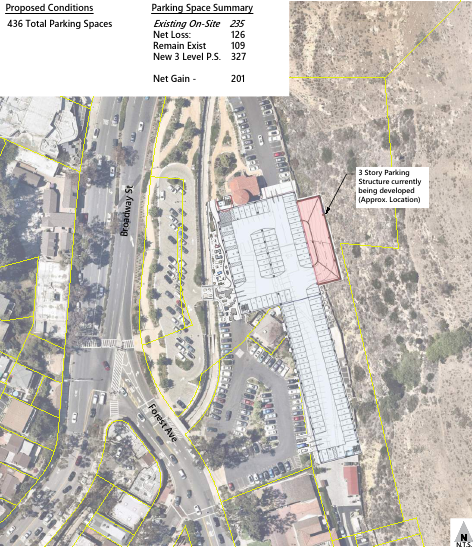
(6) Direct staff to proceed with the next steps for a 3-level 327-space parking structure at 635 Laguna Canyon Road/Farmers Market, 200 added spaces costing $81,343 per added space. Target users are downtown business employees, attendees and volunteers of Playhouse and Festival of Arts;
(8) Direct staff to study the feasibility of remote parking at Act V, 3-level 516-space parking structure at 1900 Laguna Canyon Road, 263 added spaces costing $98,099 per space. Target users are City's fleet of vehicles and trolleys, the general public primarily during summer;
(10) Direct staff to review the Complete Streets Mobility Study for "other" potential strategies.
NOTES: Since the Council unanimously carried a "motion to adopt", all PTDMR parking lots and parking structure projects remain in consideration. The 13 June Agenda Item #14 and staff report make no clarification to "complete streets" in 226-pages, no commitment for funding or qualifications are addressed. Recommendation #10 remains most vague, we have been played again.
-LS

Now a third consultant retained by LB City disputes these claims in a Parking and Transportation Demand Management Report (Jan 10 2023)* prepared by the Parking Management Subcommittee. The Subcommittee reports high parking occupancy all the time and recommends 11 new parking structures in 18 new parking lots from 23 locations studied.
"New construction public parking infrastructure is generally a long-term strategy. However, the Subcommittee also recommends that two significant infrastructure projects (new multi-level parking structures) be pursued in the medium-term."
The consultants and their reporting are:
IBI Group: Existing Parking Analysis & Recommendations for the Downtown Specific Plan Area, Mar 2017
RBF Consultants: Downtown and Laguna Canyon Parking Management Plan (PMP) 2013
City Council Parking Master Plan Subcommittee: LB Parking and Transportation Demand Management Report (Fehr & Peers Consultants), Jan 2023
Quoting from the study “Based on these observed occupancies and the current public and private parking supply, which was further analyzed according to the area’s land uses, the study resulted in three key findings.”
“Key Finding #1: The City can benefit from reducing the minimum
required parking requirements for non-residential uses in the DSP area.
The overall actual built supply of parking spaces exceeds overall actual
demand.”
“Key Finding #2: Private parking spaces are underutilized. Parking
demand in the Downtown Specific Plan area is higher in public parking
spaces than in private parking spaces during both summer and non-summer
months.”
“Key Finding #3: The Downtown Specific Plan area attracts more visitors during the summer season.”
The Consultants summarize the parking occupancy of the downtown and Laguna Canyon areas. The parking capacity in available public owned parking spaces is Summer:1977 Winter:1547. From actual traffic counts the Consultants summarize the off-street parking occupancy in downtown as 30-60% in winter and 80-100% in summer. These results also do not justify a new permanent parking structure.
• Downtown On-Street Parking Occupancy
o Summer Weekend/Weekday: 80% – 100%
o Non-Summer Weekend/Weekday: 60% – 80%
• Downtown Off-Street Parking Occupancy
o Summer Weekend/Weekday: 80% – 100%
o Non-Summer Weekend/Weekday: 30% – 60%
• Canyon On-Street Parking Occupancy
o Summer Weekend: 80% – 100%
o Summer Weekday: 60% – 90%
o Non-Summer Weekend: 60% – 80%
o Non-Summer Weekday: 5% – 15%
• Canyon Off-Street Parking Occupancy
o Summer Weekend: 70% – 90%
o Summer Weekday: 40% – 70%
Notice the difference in conclusion from the Management Plan Subcommittee, in the parking and PTDMR report (Fehr and Peers) under Benefit to Residents page 39 says:
Centralized parking creates more incentive for visitors to pay for parking for the convenience, rather than park for free in a residential area further away from their destination. We can reasonably predict that individuals are often willing to pay for this amenity based on the high occupancy trends at the Glenneyre Street parking structure and other public parking facilities.
Under Parking Capacity and Occupancy the report warns readers with this caption of the Village entrance.
Locating available parking near a destination can be challenging ...... remain at near‐full occupancy throughout the peak period. Once these areas are effectively full, remaining available parking may be scattered and difficult to locate.
The Subcommittee then proposes the solution to over-demand for parking is to add enough parking spaces to hold peak occupancy under 85%, even stacked parking if necessary for a "park once" approach to avoid motorist inconvenience (page 45).
The conclusion from IBI was the existing built parking supply exceeded overall demand, asked why this conclusion was a contradiction Fehr and Peers had no comment (page 81). The findings from RBF Consulting are also in contradiction to the Subcommittee recommendations. A winter 30-60% occupancy is already below the 85% occupancy Subcommittee target, however the RBF results were not compared.
Two outcomes of the PTDMR recommendations were proposed.
(1) to reduce the impact of visitor and employee parking in residential neighborhoods and improve the quality of life for residents; and (2) to enhance mobility in the City’s commercial areas during peak periods to benefit both residents and visitors.The first outcome to reduce parking occupancy under 85% will never be achieved today due to induced demand for parking, any land-use planner can tell you that. The second outcome suffers from the same logic of car-culture; adding more car infrastructure to improve mobility simply exacerbate car traffic in our LB Village.
What is NOT in this fabricated report: "Complete Streets Policy" does not appear anywhere in the 141-page PTDMR. The keywords in the short-list "induced demand, multi modal, mode share, transit" describing a balanced mobility plan to reduce parking demand does not appear anywhere in the PTDMR.
In 141-pages the PTDMR has completely ignored the amortized costs of financing, constructing, maintaining, operating and enforcing parking structures. The Subcommittee and City Staff dream of operating 1950 parking lots like a 2023 city ATM Machine without analyzing life-time facility costs. DO THE MATH as Laguna Streets have done. Check these parking meter rates for 11 structures and decide if you would park there or in a neighborhood for FREE!
Consultants report the recommendations they are retained to produce. In this case the clear disagreement between three consultants is revealing, the Parking Management Subcommittee has an agenda to sell parking.
-LS
* A new revision June 13 2023 replaces Jan 10 2023 report.

